

Why Soft Cases Protect Better for Families
Every parent knows the worry when a smartphone slips from little hands during the chaos of a busy London day. With families relying on these devices for everything from school pick-ups to weekend plans, keeping them protected becomes a real concern. Soft phone cases made from silicone or TPU provide a cushion against everyday bumps, scratches, and drops, helping your device withstand family life without adding unnecessary bulk. Discover practical everyday protection that suits both your routine and your children’s needs.
Table of Contents
- Soft Phone Cases And Their Protective Purpose
- Key Types Of Soft Cases And Materials Used
- How Shock Absorption Prevents Device Damage
- Comparing Soft Cases With Hard Alternatives
- Common Mistakes And Maintenance Tips For Families
Key Takeaways
| Point | Details |
|---|---|
| Soft cases provide practical protection | They absorb shocks and cushion against everyday bumps, making them ideal for family life. |
| Material matters | Silicone and TPU offer good grip and durability, while leather provides a premium feel but requires more maintenance. |
| Regular maintenance is essential | Inspect cases for wear and perform regular cleanings to ensure continuous protection. |
| Hybrid designs combine benefits | Hybrid cases offer a balance of shock absorption and scratch resistance, suitable for active households. |
Soft phone cases and their protective purpose
Your smartphone is one of your family’s most frequently used devices. Soft phone cases offer practical everyday protection that works for busy households where drops and bumps are simply part of life.
What soft cases actually do
Soft phone cases are made from materials such as silicone, TPU, or leather, designed to snugly fit around phones and cushion them against scratches, bumps, and minor impacts. Unlike rigid cases that crack under pressure, soft materials absorb shock naturally.
These cases excel at protecting your device’s everyday surface from daily wear and tear. The protective layer prevents cosmetic damage that accumulates over months of regular use.
Key protective benefits for family life
Soft cases deliver several advantages particularly suited to family routines:
- Scratch resistance – Guards the back and sides from contact damage during school runs and sports activities
- Bump absorption – Cushions minor drops that happen when children pass phones between siblings
- Dust prevention – Keeps dust and debris away from ports and charging connections
- Slim, comfortable fit – Maintains usability whilst still providing meaningful protection
How they protect differently than hard cases
Hard cases stop impacts by becoming rigid barriers. Soft cases work opposite: they absorb energy through compression, reducing the force that reaches your phone. This difference matters for family use where unpredictable handling is common.
Thermoplastic polyurethane (TPU) cases offer protection mainly against scratches, dust, and minor bumps whilst slightly increasing bulk. They primarily safeguard the back and sides while maintaining a slim profile that fits easily in pockets.
When soft cases work best
These cases shine in everyday scenarios:
- Daily commuting and school drop-offs
- Casual handling around the home
- Protecting phones whilst children carry them
- Maintaining phone usability without excessive bulk
- Extending device lifespan during regular use
Soft cases balance everyday protection with practicality—ideal for London families prioritising usable devices over rugged durability.
They’re not designed for extreme protection. If your family regularly participates in outdoor sports or high-risk activities, you may need additional reinforcement. But for standard household use, soft cases provide the protection most families actually need.
Pro tip: Choose cases with textured finishes—they grip hands better and reduce accidental drops during quick handovers between family members.
Key types of soft cases and materials used
Not all soft cases are created equal. Different materials offer varying levels of protection, grip, and durability. Understanding which material suits your family’s needs helps you choose a case that actually works for your lifestyle.
Silicone: The flexible choice
Silicone cases remain popular for good reason. They stretch slightly when your phone drops, absorbing impact energy. This flexibility prevents sudden jolts that can damage internal components.
Silicone grips well, reducing accidental slips from children’s hands. The material also resists discolouration over time, unlike some alternatives that yellow or stain.
One downside: silicone collects dust and lint easily. Regular cleaning keeps them looking fresh.
TPU: Balanced protection and style
Thermoplastic polyurethane (TPU) delivers a practical middle ground between softness and durability. It’s tougher than silicone but still absorbs impacts effectively. Phone case material types balance protection and style by combining functionality with appearance.

TPU resists yellowing better than silicone and handles daily wear without degrading. It maintains its grip longer and looks more polished on modern phones.
Leather: Premium and practical
Leather cases offer durability that improves with age. They develop character as your family uses them, creating a unique patina. Premium leather provides genuine protection whilst feeling natural in hand.
Leather cases require occasional conditioning to prevent cracking. They’re typically more expensive than silicone or TPU alternatives.
Material comparison for family use
Here’s how materials stack up for typical household scenarios:
- Silicone – Best grip, lowest cost, collects dust
- TPU – Balanced protection, resists yellowing, mid-range price
- Leather – Premium feel, improves with time, needs maintenance
- Hybrid – Combines materials for targeted protection in high-impact areas
Hybrid cases: Smart combination
Many cases blend materials strategically. Soft outer layers absorb shocks whilst reinforced edges protect corners where phones typically land. This approach maximises protection without excessive bulk.
Hybrid designs work well for families with multiple phone users. They handle unpredictable handling patterns better than single-material cases.
To help you choose the ideal phone case material, here’s a quick comparison of features relevant to families:
| Material | Grip Quality | Maintenance Needed | Durability Over Time |
|---|---|---|---|
| Silicone | Excellent, highly grippy | Regular cleaning | Prone to dust, fair longevity |
| TPU | Good, less sticky | Low effort, easy to clean | Retains appearance, moderate |
| Leather | Smooth, comfortable | Needs conditioning | Improves with age, costly |
| Hybrid | Customisable by design | Depends on mix | High protection, versatile |
The best material for your family is the one your children will actually use without complaint—grip matters as much as protection.
What happens inside the material
All soft materials work through compression. When your phone hits something, the material flattens momentarily, spreading impact force over time rather than instantly. This process reduces stress on internal components.
Denser materials compress slower but absorb higher-impact forces. Lighter materials compress faster, protecting against minor drops but offering less extreme-impact protection.
Pro tip: Test how the case feels in your hand before buying—comfort matters for family members of different ages, and a case that feels awkward gets dropped more often.
How shock absorption prevents device damage
Your phone contains delicate electronic components that don’t handle sudden impacts well. Shock absorption works by slowing down the force that reaches your device when it drops, protecting internal circuitry from damage.
Understanding impact force
When your phone hits the ground, the impact happens in milliseconds. Without protection, all that force transfers directly to internal components like the screen, battery, and processor board.
Soft cases extend the collision time. Instead of stopping instantly, your phone compresses slightly into the case material, spreading the impact over a longer period. This simple difference prevents catastrophic internal damage.
How soft materials absorb energy
Shockproof cases absorb impacts by cushioning the phone, reducing the force of drops and preventing internal damage. Common materials like silicone and thermoplastic elastomer (TPE) provide flexibility that compresses on impact.
Think of it like the difference between landing on concrete versus landing on a trampoline. The trampoline doesn’t stop your fall instantly. Instead, it slows your descent gradually, distributing force across a larger area over a longer time.
The role of case design
Material alone doesn’t complete the job. Strategic design elements amplify protection:
- Reinforced corners – Absorb shock at the most common impact points
- Raised edges – Create space between your screen and surfaces when dropped face-down
- Textured surfaces – Prevent rolling and reduce drop likelihood altogether
- Hollow sections – Allow material to compress without transferring force to the phone body
What happens inside your phone
Your device contains circuit boards connected by delicate solder joints. Sudden impacts create vibrations that can crack these connections. Gradual force distribution prevents these internal micro-fractures from developing.
Batteries are particularly vulnerable. Hard impacts can cause internal battery damage that creates safety risks months later. Soft cases prevent these hidden injuries entirely.
Protection against multiple drop types
Families face different drop scenarios:
- Low drops from child height (1-1.5 metres)
- Pocket drops during active movement
- Fumbled handovers between family members
- Impacts from sports or outdoor activities
Soft cases excel at absorbing these common household impacts. They won’t protect your phone from being run over by a car, but that’s not what family protection requires.
Shock absorption works by spreading impact force over time and area—your case is a time-stretcher, not a force-eliminator.
Real-world protection testing
Drop tests measure how far phones survive before screen damage occurs. Devices in soft cases typically survive drops 50-100% higher than unprotected phones. A 1-metre drop in a hard case might crack the screen, whilst the same drop in a quality soft case remains damage-free.
Your family’s actual experience involves dozens of drops annually. Each one is an opportunity for damage. Soft cases prevent cumulative harm from these everyday incidents.
Pro tip: Inspect your case quarterly for compression deformation—if the material no longer springs back after squeezing, it’s lost shock-absorbing effectiveness and should be replaced.
Comparing soft cases with hard alternatives
Choosing between soft and hard cases means understanding what each actually protects against. Both offer legitimate benefits, but they work in fundamentally different ways. Your family’s needs determine which approach serves you better.
Hard cases: Rigid protection with trade-offs
Hard cases create a protective shell around your phone. They resist scratches effectively and maintain structural integrity over years of use. The rigid plastic or polycarbonate exterior acts like armour.
However, rigidity means less shock absorption. When your phone hits the ground hard, the case doesn’t give. All that impact force transfers directly to your device. Hard cases also feel bulky in hand, making them easier for children to drop accidentally.
Soft cases: Superior shock absorption
Soft cases made from silicone or TPU provide excellent shock absorption and grip, cushioning the phone from impacts. The material compresses on impact, spreading force over time rather than transmitting it instantly.
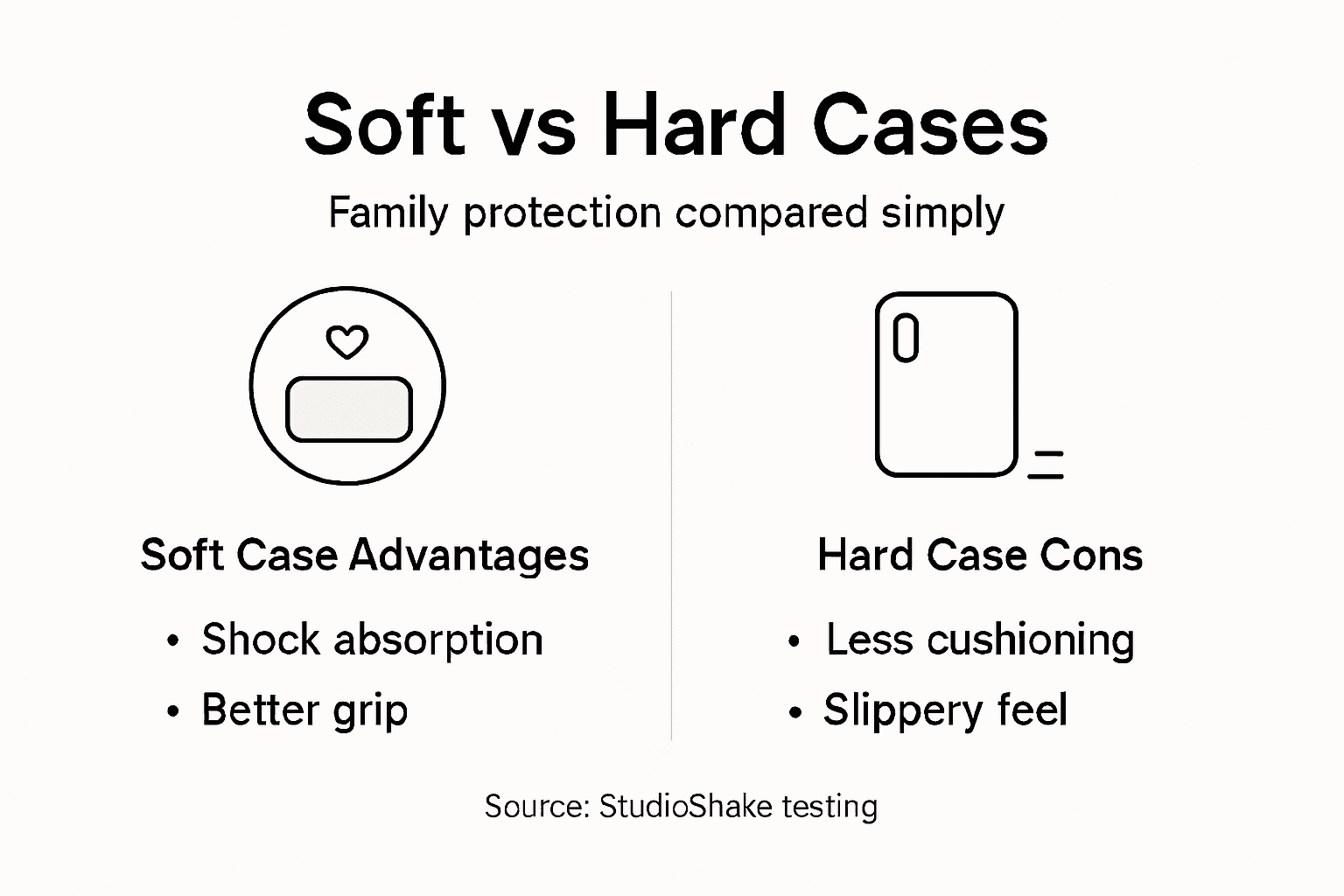
Soft cases also grip better. Children’s hands slip less from soft textures, reducing accidental drops before they happen. This prevention matters more than recovery.
Direct comparison for family use
Here’s how each performs across common scenarios:
- Drop from hand height – Soft cases excel; hard cases transfer force directly
- Scratch protection – Hard cases superior; soft cases collect dust
- Comfort and grip – Soft cases win; hard cases feel rigid
- Long-term durability – Hard cases maintain appearance; soft cases compress over time
- Screen protection – Hard cases prevent face-down damage; soft cases cushion impact
The hybrid approach: Best of both
Many families don’t need to choose. Hybrid cases combine hard shells with soft bumpers to optimise protection and handling. A rigid back prevents scratches whilst soft edges absorb corner impacts where phones typically land.
This design philosophy suits family life perfectly. You get scratch resistance without sacrificing shock absorption.
What research shows
Drop tests consistently show soft cases outperform hard alternatives in actual protection. Phones in soft cases survive higher drops before screen damage occurs. Hard cases excel at cosmetic protection but fail at preventing internal damage.
Your phone’s internal components matter more than its external appearance. Internal damage creates safety risks months later. Cosmetic scratches don’t.
Hard cases look better longer; soft cases protect better when it matters—choosing between them depends on whether you prioritise appearance or function.
Practical considerations for London families
Active households with multiple children benefit from soft cases. The grip advantage prevents countless drops before they happen. Rushed morning routines, school pickups, and sibling phone sharing all benefit from materials that don’t slip.
If your family prioritises minimalism and aesthetics, hard cases maintain that look. But accept that you’re trading protection for appearance.
Pro tip: Pair your soft case with a screen protector—you’ll get soft case shock absorption for drops plus hard surface scratch resistance on the screen where it matters most.
Common mistakes and maintenance tips for families
Cases protect your phone only when they’re maintained properly and used correctly. Many families unknowingly damage their devices by making preventable mistakes. Learning what to avoid extends both your case and phone lifespan significantly.
Mistake: DIY repairs without proper knowledge
When cases crack or phones malfunction, families often attempt fixes independently. Using incorrect tools or attempting DIY repairs without proper knowledge can worsen damage. A cracked case that’s forced back together loses protective value entirely.
Instead, follow manufacturer guidelines and seek professional repairs when needed. This maintains both device integrity and case effectiveness long-term.
Mistake: Ignoring case condition
Soft cases compress over time. Material that no longer springs back can’t absorb impacts effectively. Many families continue using degraded cases without realising protection has diminished.
Inspect your case monthly. Squeeze the corners gently—they should bounce back immediately. If material stays compressed, replacement time has arrived.
Proper cleaning techniques
Soft cases collect dust and lint. Regular cleaning maintains grip and appearance:
- Weekly – Wipe exterior with a soft, slightly damp cloth
- Monthly – Wash with mild soap and warm water, then air dry completely
- Never – Use harsh chemicals, bleach, or abrasive scrubbers that damage material
- Avoid – Machine washing or submersion that forces water into ports
Moisture and storage mistakes
Damp cases breed bacteria and promote material degradation. Always ensure your case is completely dry before reassembling it on your phone. Store cases in cool, dry locations away from direct sunlight.
Extended sunlight exposure causes discolouration and material brittleness. A drawer or cupboard provides ideal storage conditions.
Port and edge maintenance
Dirt accumulates around charging ports and case edges. This buildup prevents proper case contact and reduces grip security. Use a soft brush or toothpick to gently clear debris monthly.
Don’t force your phone into the case. Gentle placement prevents edge separation that compromises protection.
A case that’s clean, dry, and structurally sound continues protecting your phone effectively—maintenance transforms a one-year investment into a three-year solution.
Signs your case needs replacement
These indicators signal replacement time:
- Material no longer compresses back to original shape
- Cracks, tears, or permanent deformation visible
- Edges separating from the phone’s body
- Discolouration or staining that won’t clean
- Reduced grip due to material degradation
Family communication about care
Children need clear expectations about case care. Teach them that cases protect their phones, so rough handling of the case equals rough handling of the device itself. Simple reminders prevent accidental damage.
Make maintenance part of weekly routines. Sunday evening cleaning becomes habitual rather than burdensome.
The following table summarises the most common mistakes families make with soft cases and how to avoid them:
| Mistake | Risk for Device | Best Prevention Tactic |
|---|---|---|
| Using worn-out case | Reduced protection | Replace when deformed |
| Skipping regular cleaning | Loss of grip | Monthly wash and dry routine |
| Re-assembling case while damp | Material breakdown | Ensure case is fully dry |
| DIY repair attempts | Increased damage | Seek professional support |
Pro tip: Keep a spare case available—rotation extends lifespan by allowing complete drying between uses and prevents constant wear on a single case material.
Discover Reliable Soft Case Protection for Your Family’s Devices
Protecting your family’s devices from everyday mishaps is critical, especially when handling frequent drops and bumps. This article highlights how shock absorption and the right material choice provide superior protection compared to hard cases. Families need cases that combine grip, durability, and comfort to reduce accidental damage before it happens.
At StudioShake, we understand these challenges and offer a wide range of soft phone cases specifically designed to absorb impact effectively while maintaining a slim and comfortable fit. Our Technology – StudioShake collection features premium materials like TPU and silicone to match your lifestyle.
Explore our Our Bestsellers – StudioShake and find the perfect case that fits your family’s daily routines. Act now to keep your devices safe with practical, reliable protection from StudioShake. Visit https://studioshake.co.uk to browse the full selection and protect what matters most today.
Frequently Asked Questions
What are the advantages of using soft phone cases for families?
Soft phone cases offer scratch resistance, bump absorption, and dust prevention, making them ideal for everyday family use. Their slim design maintains usability while providing essential protection against minor impacts.
How do soft cases differ from hard cases in terms of protection?
Soft cases absorb impact energy through compression, which reduces the force that reaches the phone during drops. In contrast, hard cases act as rigid barriers, transferring impact force directly to the device, which may lead to internal damage.
What materials are commonly used in soft phone cases, and how do they compare?
Common materials include silicone, TPU (thermoplastic polyurethane), and leather. Silicone offers excellent grip but collects dust easily; TPU balances durability with a polished look; leather provides a premium feel but requires maintenance. Each material suits different family needs.
How can I maintain my soft phone case to ensure it continues to protect my phone?
Regularly inspect your case for signs of wear, clean it with mild soap and water, and ensure it is dry before use. Replace the case if it no longer compresses properly or shows significant wear and tear.
Recommended
- Phone Cases: Everything You Need to Know – StudioShake
- 7 Durable Phone Case Features Every Parent Should Know – StudioShake
- Phone Case Fit – Why It Matters for Parents – StudioShake
- What Is TPU in Phone Cases – Why It Matters for Families – StudioShake
- 7 praktische Kindermatten Tipps für mehr Sicherheit im Alltag – Just Mats