

Role of Smart Accessories – Enhancing Family Tech Life
Every parent recognises the struggle to keep up with their family’s fast-moving digital needs without sacrificing style or safety. In London, where tech touches every part of daily life, finding smart accessories that blend seamlessly with your family’s routine has never mattered more. From smartwatches that keep teenagers connected to voice assistants that manage busy schedules, these practical tools are shaping modern family dynamics and offering new levels of convenience. Discover how smart accessories transform not just your technology but your everyday peace of mind.
Table of Contents
- What Are Smart Accessories for Families?
- Key Types and Distinct Features
- Smart Accessories for Everyday Family Life
- Safety, Security, and Device Protection Needs
- Legal Duties, Costs, and What to Avoid
Key Takeaways
| Point | Details |
|---|---|
| Importance of Smart Accessories | Smart accessories enhance family life by automating daily tasks and improving communication. They cater to various needs, from health monitoring to home security. |
| Choosing the Right Device | Before purchasing, assess your family’s specific challenges and select devices that address those directly. Start small to gauge how technology integrates with your routine. |
| Data Protection Responsibilities | Families must understand the data collection practices of smart devices to ensure compliance with privacy laws. Prioritise security settings and maintain awareness of storage policies. |
| Long-term Cost Considerations | Evaluate total costs of ownership, including subscriptions and support, when deciding on a smart accessory. This will prevent unexpected financial burdens and ensure value for your investment. |
What Are Smart Accessories for Families?
Smart accessories are connected devices that transform how families interact with technology every single day. Think of them as the bridge between your traditional gadgets and a more intelligent, responsive environment. Internet of Things devices like smartwatches, voice assistants, fitness trackers, and connected security systems form the backbone of modern family life. These aren’t just novelty items gathering dust on a shelf. They’re practical tools designed to handle the real demands of busy household life, from coordinating schedules to managing security when you’re away.
What makes smart accessories particularly valuable for London families is how they adapt to your lifestyle rather than forcing you to adapt to them. A voice assistant can handle shopping lists whilst you’re cooking dinner. A smartwatch keeps you connected to your teenagers without requiring constant phone checking. Smart technology integration shapes family dynamics by creating new patterns of communication and shared responsibility. The University of Bristol’s Smart Living project reveals that these devices are used across generations for everything from managing home environments to maintaining family connections. Your mum might use a fitness tracker to monitor her health, whilst your child uses a smartwatch for safety and staying in touch. The variety of applications means different family members benefit in different ways.
The real power of smart accessories lies in automation and convenience. Rather than manually adjusting your home’s heating, remembering medication reminders, or tracking who’s arriving home, these devices handle those repetitive tasks automatically. They collect data about your usage patterns and preferences, then adapt accordingly. This creates a more intuitive living space where technology anticipates your needs rather than requiring constant input. For time-pressed parents juggling work, school runs, and household management, that’s genuinely life-changing.
Physical protection of these accessories matters equally to their functionality. Many families invest in quality phone cases and protective covers for their smartwatches and mobile devices to ensure longevity. These accessories aren’t expensive to replace, but when they’re integrated into your family’s daily routine, losing one to accidental damage becomes more than just inconvenient. Age-appropriate phone accessories help ensure that every family member, from young children to teenagers, can safely use their connected devices without worry.
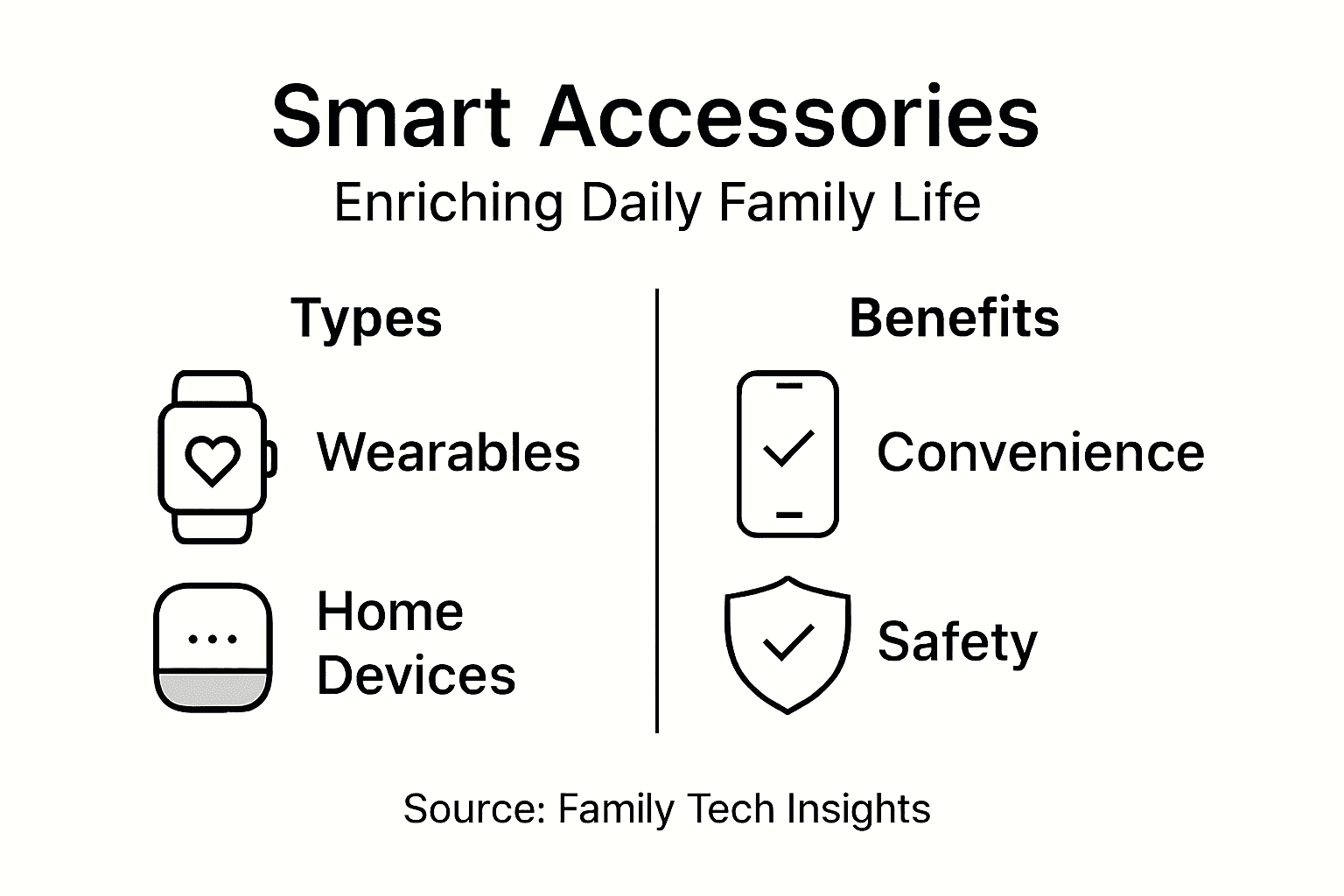
The categories of smart accessories available today span almost every aspect of family life. Wearable devices like smartwatches and fitness trackers monitor health and enable quick communication. Home automation devices manage lighting, heating, and security. Connected toys engage younger family members with interactive learning experiences. Even everyday items like water bottles and pill dispensers now come with smart capabilities that remind users to stay hydrated or take medications on schedule. This ecosystem approach means you can start small with a single device and expand gradually as you discover what works for your family.
Pro tip: Start with one strategic smart accessory that solves your biggest family challenge, whether that’s communication, health monitoring, or home security, rather than buying multiple devices at once. This helps you understand how smart technology fits your household before investing more significantly.
Key Types and Distinct Features
Smart accessories for families come in several distinct categories, each serving different purposes within your household. Understanding what separates one type from another helps you make informed decisions about which devices actually address your family’s needs. The diversity of options means you’re not stuck with one-size-fits-all solutions. Instead, you can pick and choose based on what matters most to your household right now.
Wearable devices represent the most personal category of smart accessories. Smartwatches are perhaps the most obvious example, offering communication, health tracking, and emergency features on your wrist. Fitness trackers monitor activity levels, heart rate, and sleep patterns, providing data that helps family members stay accountable to their health goals. For parents with teenagers, wearables offer peace of mind through location tracking and instant communication without requiring constant smartphone use. These devices sync with your smartphone or home network, creating a seamless information flow across your connected devices. The beauty of wearables lies in their constant presence on your body, meaning you won’t accidentally leave them behind like you might with a phone.
Home automation devices form the control centre of your smart home ecosystem. Voice assistants like Amazon Echo or Google Home act as command centres, controlling lights, thermostats, locks, and security systems through simple voice commands. Smart plugs allow you to convert ordinary appliances into connected devices by simply plugging them in between your device and the wall socket. Smart lighting systems let you adjust brightness and colour from anywhere, useful for creating routines that signal bedtime to children or simulate occupancy when you’re away. These devices learn your family’s patterns over time, adapting heating schedules to match when people are home and adjusting security settings based on your location.
Connected safety and security devices address one of parenting’s fundamental concerns: keeping your family safe. Smart doorbells with cameras let you see who’s at the front door from your phone. Window and door sensors alert you if someone opens a door unexpectedly. Motion-activated security lights deter intruders whilst providing safety for family members arriving home after dark. For families with vulnerable members, assistive technology supports independence through voice-activated controls and emergency response systems. These specialised devices go beyond general security, offering tailored solutions for individuals with specific accessibility needs or health requirements.
Connected health and wellness devices extend beyond simple fitness trackers. Smart scales measure weight and body composition, syncing data to health apps. Sleep trackers analyse sleep quality and offer insights. Connected pill dispensers remind family members to take medications at the right time. For families managing chronic conditions or supporting elderly relatives, these devices provide crucial monitoring capabilities without requiring constant manual intervention.
Entertainment and education devices keep younger family members engaged constructively. Connected toys offer interactive learning experiences tailored to different age groups. Smart displays combine video, audio, and visual information for family entertainment. These devices often include parental controls allowing you to set appropriate content boundaries.
What distinguishes quality smart accessories is how they prioritise both functionality and protection. The best devices offer intuitive interfaces that don’t require constant app checking, seamless integration with your existing ecosystem, and robust security features protecting your family’s data.
Here’s a quick comparison of major smart accessory categories and their distinct family benefits:
| Accessory Category | Main Benefit for Families | Typical Example | Common Home Application |
|---|---|---|---|
| Wearables | Real-time health and location | Smartwatch | Teen safety & parental alerts |
| Home Automation | Convenience and custom routines | Smart lighting | Wake-up and bedtime routines |
| Safety & Security | Peace of mind and monitoring | Video doorbell | Entry alerts & visitor checks |
| Health & Wellness | Automated health management | Smart scale | Medication & weight tracking |
| Entertainment/Education | Interactive learning and control | Smart speaker | Homework help, music curation |
Pro tip: Map out your family’s actual pain points before buying any smart accessories, then research which device category addresses each one specifically rather than accumulating gadgets hoping something sticks.
Smart Accessories for Everyday Family Life
The real value of smart accessories becomes apparent when you see them integrated into your family’s actual daily routines. These aren’t devices you set up once and forget about. They’re tools that quietly handle recurring tasks, freeing you from repetitive decisions so you can focus on what actually matters. A voice speaker in your kitchen plays music whilst you prepare meals. A smartwatch on your teenager’s wrist lets them know when to head home. Smart lighting adjusts as your family moves through different parts of the house. Together, these small conveniences accumulate into genuine time savings and reduced stress.

Morning routines benefit significantly from smart accessories. Voice commands can activate your shower whilst you’re getting dressed, ensuring hot water is ready when you step in. Smart speakers announce the time, weather, and news briefing whilst you’re rushing to get children ready for school. Smartwatches with integrated reminders help family members stay on schedule without you constantly chasing them down. The educational content accessible through smart displays transforms morning preparation into learning opportunities rather than rushed chaos. For younger children, interactive features make getting ready feel less like a chore and more like part of a game or routine they’ve chosen to engage with.
Afternoon and evening hours reveal another layer of benefit. Voice-controlled lights and smart speakers allow you to adjust lighting and music without stopping what you’re doing. Imagine cooking dinner with flour on your hands and simply saying, “lights to 80 percent” rather than wiping your hands to use a switch. Smart thermostats learn your family’s comfort preferences and adjust temperatures automatically, eliminating arguments about whether it’s too warm or too cold. For parents managing household responsibilities alongside work, these small automations create space for actual family time instead of constant tinkering with your environment.
Children’s safety and development integrate seamlessly with everyday smart accessories. Educational content, communication tools, and fitness tracking help children develop healthy habits whilst staying connected to family. GPS-enabled smartwatches let your child have independence to visit a friend’s house or walk to school whilst you maintain awareness of their location. Parental controls ensure they’re accessing appropriate content without requiring constant surveillance. These devices support your children’s autonomy rather than restricting it, a crucial distinction that helps them develop confidence and responsibility.
Evening routines benefit from smart lighting that gradually dims to signal bedtime, helping regulate sleep patterns for the entire family. Smart speakers can guide meditation or relaxation exercises for children struggling to wind down. Temperature adjustments create comfortable sleeping environments without anyone getting out of bed. Connected security systems let you verify doors are locked and lights are off before sleep without a final walk through the house.
For families supporting elderly relatives or members with additional needs, emergency call systems and location tracking provide crucial peace of mind. Emergency pendants offer immediate access to help, whilst location tracking ensures vulnerable family members can move about independently without putting themselves at risk. Voice-controlled devices reduce physical demands on people with mobility challenges, allowing them to control their environment through simple commands.
The accumulation of these daily conveniences reshapes how your family functions. You’re not buying technology for technology’s sake. You’re investing in systems that remove friction from routines that happen multiple times every single day. Over a week, a month, a year, those small time savings become substantial. More importantly, they create mental space. You stop worrying about whether you locked the door because your smart lock confirms it. You stop wondering if your child reached school safely because their watch location is visible. You stop scrambling when someone in the house needs emergency assistance because the system is already in place.
Pro tip: Automate your most repetitive daily decision first, whether that’s lighting, heating, or security checks, then observe how that change feels for two weeks before adding additional smart accessories to your household.
Safety, Security, and Device Protection Needs
When you invite smart accessories into your home, you’re bringing devices that collect, store, and transmit personal information about your family’s daily routines. This isn’t meant to sound alarming. It simply means you need to understand what data these devices gather and where it goes. Your smartwatch tracks your location and heart rate. Your voice assistant records conversations. Your smart doorbell captures video of everyone entering and leaving your home. These conveniences come with responsibilities. Before purchasing any smart accessory, take time to research the privacy features and understand exactly what data collection practices each device employs. Smart products collect personal data that requires careful management, making informed purchasing decisions essential for protecting your family’s information.
Data protection starts during the initial setup phase and continues throughout the device’s lifespan. When configuring a new smart accessory, pay particular attention to permission settings. Many devices request access to your contacts, location history, camera, or microphone. Grant only the permissions genuinely necessary for the device to function. Review privacy policies before activating any smart accessory, looking specifically for statements about data sharing with third parties. Some manufacturers sell anonymised user data to advertisers or analytics companies. Understanding these policies helps you make conscious choices about which devices align with your family’s privacy standards. Change default passwords immediately upon setup, using strong combinations that would be difficult for others to guess. Enable two-factor authentication wherever available, adding an extra layer of security that prevents unauthorised access even if someone obtains your password.
Physical security of smart accessories deserves equal attention to digital security. These devices are valuable targets for theft, particularly wearables like smartwatches or fitness trackers. A stolen smartwatch grants someone access to your location history and personal health data. Protective cases and secure storage prevent theft and accidental damage. Consider drop-proof protection options when selecting cases for wearable devices, as these must endure the unique demands of daily wear without restricting functionality or comfort. For home security devices like smart speakers or cameras, position them in visible but secure locations where family members know they’re present. This transparency prevents devices from recording conversations in spaces where people expect privacy. Teach children which devices are recording and why, establishing household norms around smart accessory usage.
For families with younger members, smart accessories require active parental oversight. Configure parental controls on any device children use, setting appropriate limits on content access and screen time. Review location sharing settings regularly, particularly on smartwatches. Discuss with your children why these devices track their location and how that information protects them. Make it clear that you’re monitoring their location because you care about their safety, not because you distrust them. This conversation sets a foundation for healthy attitudes towards technology as they mature.
Vulnerable family members such as elderly relatives or those with disabilities need special consideration. Smart accessories enabling their independence must also include security features protecting them from exploitation. Emergency response systems should connect directly to trusted contacts only. Location tracking devices must include privacy controls preventing unauthorised monitoring. Review these settings quarterly, ensuring they still match your family’s actual needs and circumstances.
Network security forms the invisible backbone protecting all your smart accessories. Ensure your home WiFi network uses strong passwords and current encryption standards. Update device firmware regularly when manufacturers release security patches. Some smart accessories automatically update, whilst others require manual intervention. Check your device settings and enable automatic updates where available. If a manufacturer stops supporting a device with security updates, consider whether continued use remains advisable.
Pro tip: Create a household inventory documenting every smart accessory, its default login credentials, and its privacy settings, then review this document quarterly to ensure permissions remain appropriate as your family’s needs evolve.
Legal Duties, Costs, and What to Avoid
Owning smart accessories isn’t simply about purchasing a device and using it. You have legal responsibilities that accompany these purchases, particularly in the United Kingdom where data protection laws are strict and enforceable. UK data protection laws require careful compliance including adherence to GDPR and the Data Protection Act, which establish your obligations as a data controller when you use devices that collect personal information. This means you’re responsible for understanding what data your devices gather, where that data is stored, and who can access it. You cannot simply purchase a device and ignore these responsibilities. Breaching data protection obligations can result in significant fines, ranging from £20,000 to £17 million depending on the severity and scope of the violation. More practically, your family’s sensitive information could be compromised through negligence.
The true cost of smart accessories extends far beyond the initial purchase price displayed on the retailer’s website. Most smart devices require ongoing subscriptions to function fully. A video doorbell might cost £150 upfront but require a £10 monthly subscription for cloud storage of footage. Premium smartwatch features often lock behind subscription walls. Home security systems frequently charge annual maintenance fees. Voice assistants may incur charges for premium features or additional services. When calculating whether a smart accessory makes financial sense for your family, total the purchase price, any mandatory subscriptions, expected lifespan, and potential replacement costs. A device that costs £50 but requires £120 annually in subscriptions becomes expensive over five years. Manufacturer support and software updates also carry hidden costs. When a manufacturer ceases supporting a device with security patches, you face an uncomfortable choice: continue using an increasingly vulnerable device or purchase a replacement.
Avoid devices that lack clear data disclosure policies. If a manufacturer cannot clearly explain what data their device collects, how long they store it, and who can access it, that ambiguity suggests they’re being deliberately vague about profitable data practices. Devices with weak security and excessive data sharing practices create genuine legal and financial risks for your household. Steer clear of budget brands with minimal manufacturer support. When something goes wrong with an unsupported device, you have no recourse. The company has already moved on to releasing new products. Security vulnerabilities discovered in unsupported devices remain unfixed indefinitely. You’re essentially running a digital liability in your home.
Avoid purchasing smart accessories solely because they’re trending or because marketing campaigns suggest they’re essential. The most dangerous purchase is one solving a problem you don’t actually have. If your family functions perfectly well without a voice assistant, you gain nothing by installing one, only additional security considerations and subscription costs. Similarly, avoid devices requiring excessive permissions to function. A smartwatch doesn’t need access to your entire contact list, call history, and email accounts. If setup demands these permissions and won’t proceed without them, question why the manufacturer wants that information.
Important. Never purchase refurbished or second-hand smart accessories without verifying the seller has performed a complete factory reset and provided genuine proof of ownership transfer. Smart accessories store authentication credentials and personal data. A device purchased from an unreliable source might contain malicious code or retain previous owners’ data access.
Consider the long-term viability of devices before purchasing. Manufacturers eventually discontinue products and cease providing support. Before buying any smart accessory, research how long the manufacturer typically supports similar devices. Companies with five-year support histories are significantly safer than those supporting devices for only two years. Check manufacturer websites for security update schedules and commit to a device only if you’re comfortable with its support timeline.
For informed purchasing, consider these long-term cost and legal factors:
| Factor | What to Check Before Buying | Why It Matters |
|---|---|---|
| Subscription Fees | Monthly or annual charges | True cost over five years |
| Data Disclosure Policies | Clarity on data collection/sharing | Legal compliance, privacy control |
| Manufacturer Support | Average device support lifespan | Ongoing security and stability |
| Update Frequency | Regularity of software/firmware fixes | Reduces risk of exploits |
| Resale Source | Authenticity and reset confirmation | Avoids inherited data risk |
Pro tip: Before purchasing any smart accessory, calculate the true five-year cost including subscriptions and potential replacements, then compare that figure to the value it genuinely adds to your family’s daily life before committing financially.
Protect Your Family’s Smart Accessories with StudioShake
Smart accessories enhance family life by offering convenience, safety and health monitoring. However, as the article highlights, these valuable devices require reliable protection to maintain their functionality and longevity. From smartwatches tracking your teenager’s location to voice assistants managing your home, accidental damage and daily wear can quickly undermine their benefits.
At StudioShake, we understand these challenges and provide a comprehensive range of phone cases and mobile accessories designed to safeguard all your devices. Our protective solutions blend durability with style, helping you maintain peace of mind while letting your family enjoy the full advantages of smart technology. Discover how easy it is to keep your smart accessories secure by exploring our collection at StudioShake. Don’t let drops or scratches disrupt your connected household—act now and give your family’s essential tech the protection it deserves. Explore the range and secure your smart devices today.
Frequently Asked Questions
What are smart accessories for families?
Smart accessories are connected devices that enhance family life by automating tasks, improving communication, and providing convenience through the Internet of Things. Examples include smartwatches, voice assistants, and connected home security systems.
How do smart accessories enhance everyday family life?
Smart accessories simplify daily routines by automating repetitive tasks. For instance, voice assistants can manage shopping lists while cooking, and smartwatches provide health tracking and communication features for family members, making everyday interactions smoother and more efficient.
What types of smart accessories are available for different family needs?
Smart accessories fall into several categories: wearable devices for health tracking (like smartwatches), home automation devices for managing the home environment, connected safety and security systems for protecting the family, health and wellness devices for monitoring well-being, and educational toys for children.
How can I ensure the security and privacy of my family’s data with smart accessories?
To ensure security, carefully review the privacy settings during setup, grant only necessary permissions, use strong passwords, and enable two-factor authentication. Regularly update device firmware and conduct quarterly audits of your privacy settings to maintain data protection.